
The 2013 Boy Scout National Jamboree, Summit Bechtel Reserve, West Virginia - Page 2

| Summit Bechtel Facts Continued |
|
The Summit property was once the site of extensive coal mining, an
industry for which the state of West Virginia is known. The former surface mines on the
property created wide flat areas that tier the terrain into a series of benches,
effectively pre-grading and excavating the property, and allowing for many of the roads and
infrastructure sites on the property to begin construction without extensive earth moving. Sections of the property contain large flat areas engineered to accommodate regional camp headquarters and sub-camps. The sub-camp farthest from The Summit’s core area will be 1.3 miles, with an elevation gain of no more than 300 feet. Pedestrian pathways reduce walking times from regional camps to the core activity center to 12-15 minutes. A permanent arena on the far side of the valley will seat 6000 to 8000 people, which will be built as a natural extension to the property’s lower bowl amphitheatre section, for a total arena area large enough for 80,000 people during the national Scout jamboree. The partnership with the coal industry continues during the development of the site, with the building of a triple-walkway pedestrian suspension bridge sponsored by CONSOL Energy. The bridge will be just shy of 800 feet in length, and was made possible by the $15 million donation of CONSOL. The bridge will connect the western and eastern portions of the core areas of the property. Being the first Jamboree at the new Summit-Bechtel Reserve there were difficulties. There were restrictions placed on participants and staff members, which in retrospect were probably carefully thought out, but at the time angered many former staff members. Weight and age limits were introduced, National leaders realized that there would be more walking for staff members and people needed to be in good physical condition. Getting enough staff became a problem and ultimately some requirements were relaxed. When some staff people learned their cars were parked miles away from base camp, with no or little transportation to them, or that some subcamps were miles apart, they realized the reasons for the restrictions. The facilities were near competition, but some of the logistics had not been completed. Bus service, or lack thereof, was a problem throughout the Jamboree. In 2010 the idea of a “digital” Jamboree was introduced and many things were available digitally. Scouts were asked to bring their smart phones and plans were made to rent “J phones”, but there were shortages and a limited number of charging stations created difficulties. The Summit was to be and would be Scouting's “super bowl”, (my term), but it wasn’t quite ready in 2013. There were a lot of repercussions that would be addressed and most remedied by 2017. It should be noted that after 2013 obtaining sufficient staffing for Jamborees would be a greater challenge. |
| About the Summit |
|
The Summit Bechtel Family National Scout Reserve, is often
abbreviated as Summit Bechtel Reserve. It’s located in Fayette and
Raleigh counties, West Virginia near Beckley, W. Va. about an hour
south of Charleston. There is a wealth of information about the
Reserve, interested people can search the web for Summit-Bechtel
Reserve and find all the pertinent details. The BSA had been holding National Jamborees on “other peoples” property since 1937. Every time the location changed the BSA poured hundreds of thousands of dollars into the site. In 1953 undeveloped property in California was turned into a Jamboree site. In 1960 cattle grazing land in Colorado was turned into a Jamboree site. The BSA thought they had found a permanent home in Ft AP Hill in Virginia. Just south of Washington DC and with Civil War history nearby, The Hill seemed the perfect place for Scouts to visit historic sites and celebrate Americana while attending a Jamboree. Eight Jamborees were held at AP Hill and each year the BSA spent more and more money into the facilities. By 2010 Ft A P Hill was the perfect Jamboree site. Several generations of Scouts had grown up thinking “the Hill” was the Jamboree home. There was trouble brewing on the national political scene. In the past no politician would oppose Citizenship and Character Building through an outdoor program. But the BSA made powerful enemies with it’s stances on societal issues. There was a percentage of politicians representing a growing section of the electorate that believed the BSA values might not be right for the new century. It’s the old battle between left versus right, the left is always better mobilized and usually wins. Unfortunately, some of the BSA national leaders seemed to agree with what proved to be not just detractors but real enemies of Scouting. 40,000 Boy Scouts visiting the capitol and celebrating America with flags waving at an army base south of Washington seemed a bad idea to some people. Scouting has many influential and wealthy people that supported the program. It was becoming evident that Scouts might not be welcome at A P Hill much longer. Friends of Scouting took action. It was a huge undertaking spearheaded by the Bechtel family, with many other individuals involved. The plan was not only to have a permanent home for the Jamboree, but to develop a high adventure camp, similar in some ways to Philmont, in the eastern USA. I’ve coined the slogan a “disney land” for Scouting, not referring to the corporation, but meaning a fun place where so many wonderful opportunities are available. The location was not idea, and the land had been a worn out old coal mine. The state of West Virginia was incredible in supporting the project with land and financial support from throughout the state. It took millions of dollars to convert an old mined out area into a beautiful Jamboree site. If anyone had realized the trials and tribulations the BSA would endure after 2013 the project would probably have been reconsidered, but the Summit is a reality and hundreds of thousands of Scouts will enjoy it in the future. Again for more information web search Summit Bechtel Reserve. |
| National Leadership at the 2013 Jamboree |
   |
|
The trend of having patches for National officers and other
Jamboree dignitaries to pass out as friendship exchange
continued. I was amused when I realized that there were four
Assistant Chief Scout Executives. I couldn’t help but wonder
what the “executive” payroll at National must have been in 2013.
I believe most of these, perhaps not the religious issues, to be
officially issued. -Below - Other patches celebrated the benefactors that helped finance many of the facilities at the Summit. |
 |
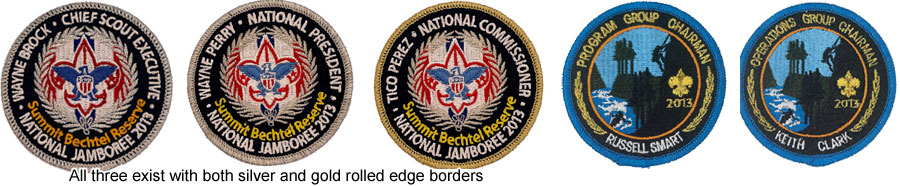
| 2013 Jamboree high level position patches |
  A
set of six patches were worn by high level Jamboree leaders. They
were not friendship exchange patches. A
set of six patches were worn by high level Jamboree leaders. They
were not friendship exchange patches.A set was available at the pre-Jamboree Trade-o-ree for a substantial price. A friend did not acquire them, but made a note of the I D numbers. After the Jamboree, his local Scout Shop ordered them for him at cost, except the Operations Chairman which did not have a tag on the back. Coming out of National BSA Supply answered any question about being “official”. The image to the upper left shows Randall Stephenson wearing the patch at the Jamboree 2013 Jamboree. These were used in 2013 and 2017 and are among the most obscure Jamboree collectibles. |
| Official pre-Jamboree 2013 Activity Area Patches |
    |
|
This set of 20 was issued a few at a time over a period of several
months. One couldn’t buy the set all at once, unless there were
earlier ones unsold in the Scout shops. However they were produced
in huge quantities and were available well after the Jamboree often
as low at .10 cents each. Thanks Dave Scocca. They were available at Scout Shops in local Councils. The theme was to expose Scouts and leaders to all the program opportunities available at the upcoming Jamboree. I’ve editorialized about how the Jamboree needed to promote the fun and adventure aspect of the Jamboree better. These seem to be an effort to do that, in addition it’s another fund raising opportunity. |
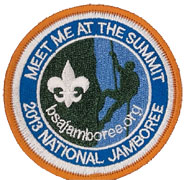 Another pre-Jamboree promotional patch. A 3” diameter round was used as a pre-Jamboree promotion item. It’s interesting, actually madding to me, I can not seem to find more information on this badge. I posted it on a Facebook page with 7000+ members asking for help identifying it. I received no definitive information. The Jamboree was only 13 years ago. I guess that’s partially why I’ve devoted so much effort and money to this project. |
|
|
| Paul Myers Goshen,
Indiana gimogash@comcast.net |